
𝟐𝟎𝟐𝟔 𝐏𝐒𝐋𝐄 𝐄𝐧𝐠𝐥𝐢𝐬𝐡 𝐎𝐫𝐚𝐥 𝐃𝐚𝐲 𝟐: 𝐄𝐚𝐬𝐲 𝐀𝐠𝐚𝐢𝐧?!

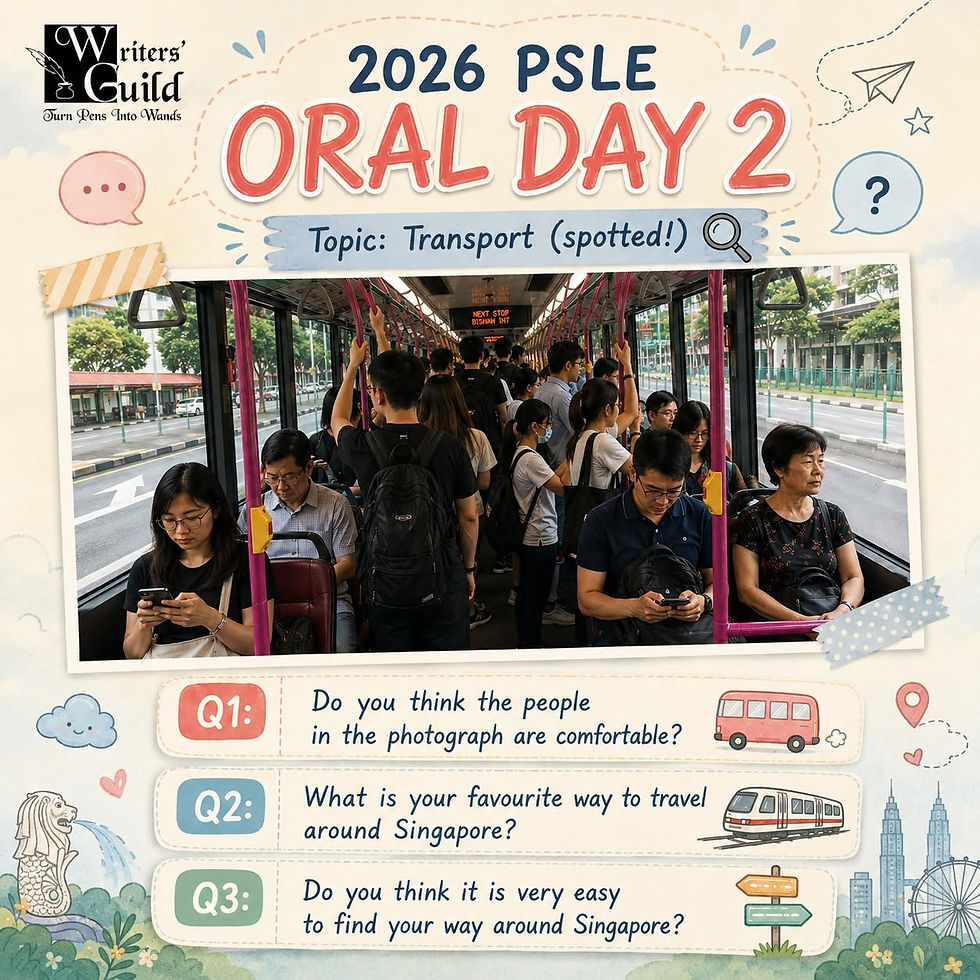
After the surprisingly familiar topic on Day 1 of the 2026 PSLE English Oral examination, parents of children taking the examination on Day 2 were understandably nervous.
We heard variations of the same prediction.
“Day 1 was so easy. Day 2 is surely going to be difficult!”
Some parents were crossing their fingers.
Maybe the difficulty would suddenly spike and an obscure topic was coming.
Then Day 2 arrived.
2026 PSLE English Oral Day 2 Stimulus Conversation
Topic: Transport
Q1: Do you think the people in the photograph are comfortable?
Q2: What is your favourite way to travel around Singapore?
Q3: Do you think it is easy to find your way around Singapore?
Q4: Have you ever experienced the MRT breaking down?
Easy… again?!
To everyone's surprise, students received another highly accessible theme.
Transport is a common topic in Oral guidebooks and has even appeared in school assessments (WA) and even recent preliminary examinations. Most students would therefore have encountered similar questions during their preparation.
We were over the moon to hear many of our P6 students sharing their happiness and relief after the PSLE examination.
However, as we have discussed in our Day 1 article:
An easy topic does not necessarily mean easy marks.
Day 2 presented a rather interesting paradox.
The Transport Paradox: Familiar Topic, Unfamiliar Experience?
Almost every 12-year-old in Singapore knows what a bus or MRT train is.
Yet that does not mean every 12-year-old has actually had to navigate Singapore independently.
In fact, this topic may have been easier for children who regularly take public transport on their own than for those who are usually chauffeured around by their parents or grandparents.
A child who independently travels home from school may have encountered missed bus stops, crowded trains, confusing interchanges, route changes and the occasional moment of wondering,
“Wait… am I going in the right direction?”
Those experiences become useful material during an Oral examination. This is why we also encourage parents to expose children to common Singaporean experiences and regularly talk about these moments during family conversations.
Another child may use public transport only when accompanied by his or her parents. Mummy decides which MRT line to take while Daddy checks Google Maps. The child simply follows.
When the examiner asks,
“Do you think it is easy to find your way around Singapore?”
The child may suddenly realise,
“I've never actually had to.”
Does that mean the child has nothing to say?
Absolutely not.
Based on our years of preparing students for English Oral, here are some difficulties students may have encountered on Day 2 and how we would approach them the Writers' Guild way.

Q1: Must Everyone in the Photograph Be Comfortable or Uncomfortable?
This looks like a very simple question.
“Do you think the people in the photograph are comfortable?”
A student looks at the crowded bus and quickly decides,
“No, they are not comfortable because the bus is crowded. The passengers are packed like sardines in a can.”
We would want students to look more carefully at the photograph.
Are all the passengers actually experiencing the same thing?
Some are sitting while others are standing.
A stronger candidate would recognise that there is no need to force everyone in the photograph into a single category.
The passengers who managed to get seats might be relatively comfortable. They can rest during their journey and do not need to worry about maintaining their balance when the bus moves or brakes suddenly.
Those standing, however, may have a very different experience. They have less personal space, need to hold onto the handrails and may find a long journey tiring, particularly if they are carrying heavy school bags or shopping bags.
A student could therefore say:
“I think it depends on which passengers we are referring to. Those who are seated probably feel relatively comfortable because they can rest during the journey. However, the passengers who are standing may feel more uncomfortable as the bus is crowded and they have less personal space. They also need to hold onto the handrails to maintain their balance whenever the bus moves or brakes.”
Instead of immediately choosing Yes or No, the student has noticed a distinction, considered two perspectives and supported both with evidence from the photograph.
That is a much more thoughtful response. Sometimes, the strongest answer is not an absolute one.

Q2: “What If My Favourite Way of Travelling Is NOT Public Transport?”
This is where some students fall into an Oral trap.
The photograph shows public transport and the topic is on transport.
Therefore, they will assume that the “best” answer is,
“My favourite way to travel is by bus.”
Why?
Students sometimes feel there must be a “correct” answer, particularly when the stimulus appears to point them in a certain direction.
Our advice is the same as it was on Day 1:
Give your genuine opinion.
If your favourite way of travelling around Singapore is in your father's car, say so.
A student could respond:
“Although I usually walk home on my own after school, my favourite way to travel around Singapore is in my father's car. My family regularly jokes that my father is my personal Grab driver! I enjoy travelling by car because it is comfortable and convenient, especially when we are going somewhere that requires several bus or MRT transfers… …”
Suddenly, the response has personality. It tells us something unique about the child.
It sounds like a 12-year-old speaking about his or her actual life, rather than a child reciting what he or she thinks an examiner wants to hear.
Why does that matter?
PSLE Oral examiners listen to multiple candidates in a day. Generic answers can become repetitive:
“I like taking the MRT because it is fast and convenient.”
“I like taking the bus because I can look at the scenery.”
There is nothing inherently wrong with either answer.
However, a genuine anecdote about Dad being the family's “personal Grab driver” can make a conversation more memorable and engaging.
We have even had students tell us,
“I don't like taking buses because I find them inconvenient. Even my parents book a Grab when the place is difficult to get to.”
Is that a “wrong” answer?
No.
For a personal-response question, students are not awarded marks for choosing the most socially desirable mode of transport.
They are assessed on how well they communicate and support their ideas.
A convincing, well-supported preference for travelling by car can make a much stronger response than an artificial speech about loving public transport.

Q3: “What If I Have Never Had to Find My Way Around Singapore?”
This may actually have been the most challenging question of the three. In fact, for this topic, most students have sufficient subject-specific vocabulary to elaborate. Yet we sometimes forget something very obvious.
These candidates are 12 years old.
Many children simply have not had much reason to navigate Singapore independently.
Their parents decide where they are going and check the route. They tell the children when and where to alight.
What happens when a child has no meaningful personal experience to recount?
This is precisely why we teach our students not to rely solely on themselves when generating ideas.
At Writers' Guild, one strategy students can use is GIF: Global, Individual, Family and Friends.
If you lack a strong personal experience, widen your lens.
You can draw upon what you have observed, what your family members have experienced, what your friends have told you, or what you know about the wider world around you.
A student might therefore say,
“Although I rarely need to find my own way around Singapore because I usually travel with my parents, I think it is relatively easy to do so. I have seen my parents use Google Maps and bus apps whenever they are unsure of the route and these applications give very clear directions.”
The student can then move from Family to Individual observation:
“I have also noticed that MRT stations have clear maps and signs showing the different train lines. Inside the trains, there are digital displays showing the current and upcoming stations, so even someone who is unfamiliar with the route can check whether he or she is travelling in the correct direction.”
A sophisticated candidate could go one step further.
Easy for whom?
A tech-savvy 12-year-old who speaks English may find our transport system straightforward.
Would an elderly person who is uncomfortable using smartphone applications find it equally easy?
A stronger candidate could acknowledge the nuance.
“Overall, I think Singapore is relatively easy to navigate because our public transport system is well-connected and there are many signs and digital tools available. However, it may still be challenging for elderly people who are less comfortable using navigation apps.”
That is a much more considered response than simply:
“Yes, Singapore is small and has a well-connected transport system.”

How Our Students Nailed Their PSLE Oral Exams: Raw Feedback
Easy Questions Can Still Reveal Different Levels of Thinking
This may be the biggest lesson from the first two days of the 2026 PSLE English Oral examination.
The topics have been accessible.
Day 1: Playground and Free Time Activities
Day 2: Transport
Almost every child could say something.
That does not mean every child would say the same quality of something.
This is why Oral preparation cannot simply be about predicting topics and memorising model answers.
Students need to know how to think when the question in front of them is not exactly the one they practised.
They need strategies for generating ideas and justifying an opinion.
Most importantly, they need the confidence to say what they genuinely think and not what seems “correct”.
The PSLE Oral Cheat Code: Real Sigma Answers
Two “Easy” Days in a Row?
In terms of topic accessibility, we would say yes. For the second day running, students encountered a familiar, age-appropriate theme that most could readily understand. A student does not need to have travelled across Singapore alone to answer a question about navigation. He or she does not need to claim that the MRT is a favourite mode of transport simply because the stimulus shows public transport.
Familiarity gives you something to say.
Thinking skills determine what you do with it.
At Writers’ Guild, these are the thinking skills we develop through regular, scaffolded discussions, structured frameworks and one-to-one Oral practice in our English classes. That cannot be replicated with a model response, whether found in a guidebook or generated instantly by AI.


Comments